Best Insurance Document Processing Software in 2026: 9 Tools Compared

The short version
If you only read this far, here is who I'd point where.
Building extraction into your own product? Look at Sensible if you want insurance-native parsers, or Mindee if you want the cheapest API with a price you can read off the website. Running a large carrier that needs on-prem and a name procurement already trusts? ABBYY. Want a model built only for insurance and have the budget for an enterprise rollout? Roots Automation. Sitting in the EU with data residency on your mind? Klippa.
And if you're an ops team — a brokerage, an agency, an MGA — that just wants to point something at your policies, ACORD forms, and loss runs this week without booking a sales call, start with Parsli or Docsumo. We build Parsli, so I'll be straight about where it wins and where it doesn't below.
One honesty note before the list: we make one of these tools, and we have not run your documents through the other eight. What follows is what each product is genuinely built for, and where its own customers say it strains. It is an informed vendor's read, not a lab bench-test, and I'd rather you know that going in.
Why insurance breaks most "document AI"
Generic OCR sells you on a tidy invoice. Insurance is the opposite of tidy, in three specific ways.
The forms are standardized in name only. ACORD maintains hundreds of them. The ACORD 25 certificate of liability, the 125 commercial application, the 140 property section, the loss-notice forms behind every first notice of loss. On paper they're uniform. In the wild, every agency management system and carrier exports them with different fonts, shifted fields, and supplements stapled on, so a tool that learned one layout fumbles the next.
The data you actually want is buried in prose. Coverage limits, deductibles, named insureds, and exclusions sit on the declarations page and inside policy language, not in labeled boxes. A loss run is five years of claims history formatted however the carrier felt that morning. Reading "total incurred per claim" off one reliably is a harder job than reading a total off a receipt.
And the cost of one wrong field is real. Fat-finger a limit during claims intake or underwriting and you've mispriced the risk or slowed a settlement. Manual keying runs a 1–4% error rate per 100 entries. It's slow, too: McKinsey has put the automatable share of claims cost, mostly people retyping documents into systems, at roughly 25–30%.
So the real bar is higher than "can it OCR." It has to read a carrier it's never seen, find the fields that matter, say when it isn't sure, and hand clean data to the systems your team already uses. With that bar in mind, here's the field.
What actually matters when you choose
Four things separate the tools that survive contact with a real insurance inbox from the ones that look good in a demo:
- Does it read layouts it has never seen? This is where template tools and frontier-model tools split hardest. If you have one carrier, anything works. If you have forty, you need a tool that reads by meaning.
- Does it cover the documents you live in? ACORD forms, dec pages, loss runs, COIs, FNOL forms. A few ship pre-built insurance models; most expect you to train your own.
- Will it tell you when it's guessing? Field-level confidence and a review queue are the difference between "automated" and "automated and wrong."
- Can you start without a procurement cycle? Half of this list won't show you a price without a call. For a small agency, that sales cycle is itself a cost.
The 9 tools, ranked by who they're for
1. Parsli — reads any carrier without a template
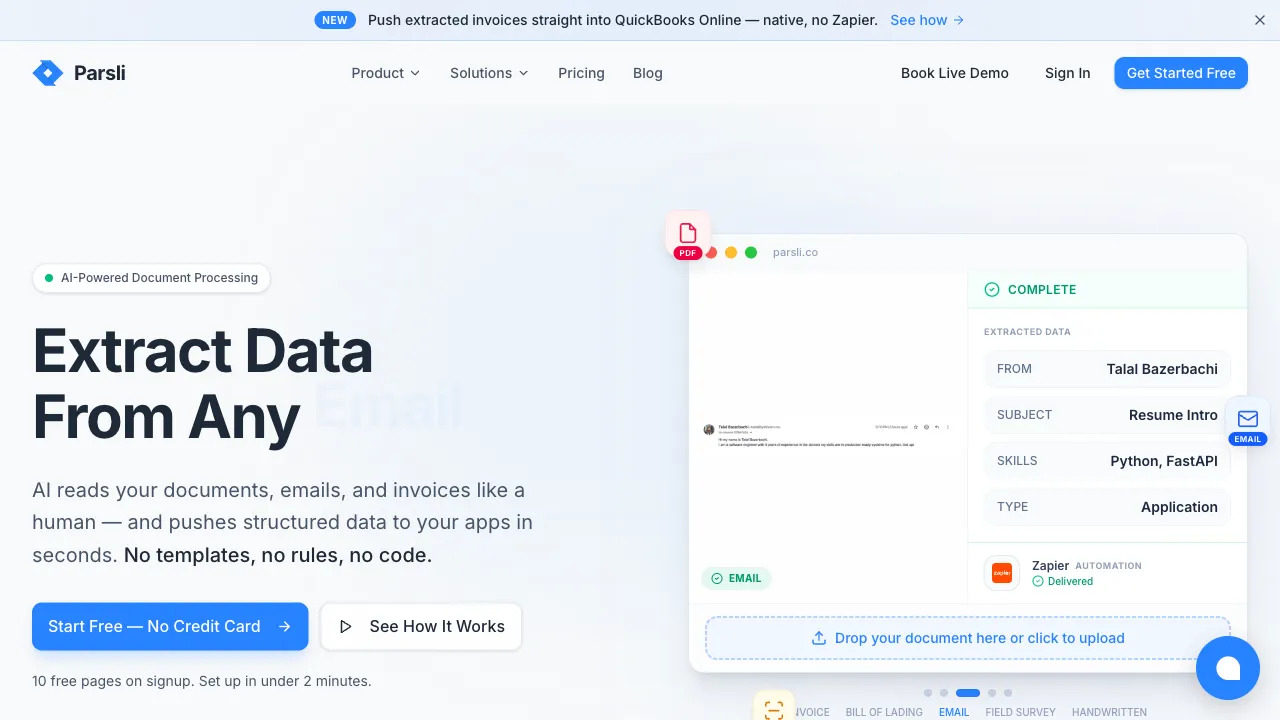
Full disclosure first: we build Parsli, so weigh this entry accordingly. It runs on frontier vision models and reads a document by understanding it, which means it handles a carrier it has never seen with no template, no zones to draw, and no training set. On an insurance file that's the whole game, because the layouts never hold still.
In practice it pulls the fields a broker or underwriter actually rekeys: policy number, named insured, carrier, each coverage with its limit and deductible, endorsements, exclusions, and the premium, off full policies, declarations pages, and loss runs from any carrier. Every field comes back with a confidence score, and it's built to leave a field blank rather than invent it, so a missing deductible reads as missing instead of guessed. Pricing is on the website: free for your first 5 pages, no card, then plans from $25 a month, with the full API on every tier.
Where it's the wrong call: there's no on-prem option and no badge that says "ACORD-certified," because it reads forms by understanding them rather than from a named, audited template. If your security team requires self-hosting, or your board wants a vendor with a twenty-year procurement track record, that's ABBYY's job, not ours.
Point Parsli at a messy loss run or a scanned dec page and see what comes back. Free for your first 5 pages, no sales call.
Try it for free2. Docsumo — the closest thing to an insurance-native cockpit
If you want a screen your team works in rather than an API your engineers call, Docsumo is the strongest pick here. It's built for financial-services and insurance back-offices and actually names the documents: ACORD forms, policies, submissions, quotes, binders, endorsements, with classification and a human-in-the-loop reviewer for the fields the model flags.
The catch is price. The Business and Enterprise tiers are quote-only, there are setup considerations that scale with complexity, and the credits expire monthly. Third-party comparisons put effective cost somewhere around 30 to 50 cents a page, but Docsumo doesn't publish that, so don't quote me on it. Skip it if seeing a price before a sales conversation is a deal-breaker for you.
3. Sensible — the insurance-native one, if you're a developer
Sensible is the most insurance-aware API on the list. Its pitch is making the data in insurance documents "as easy as calling an API," and it backs that up with a library of pre-built extractors for the exact documents you care about: ACORD 25, loss runs, dec pages, policies, quotes, EOBs. Named insurtechs lean on it specifically for loss-run and declarations-page extraction, which is about as strong a signal as this category offers.
It is, though, a developer tool. The floor is $499 a month, and there's no point-and-click cockpit for a non-technical reviewer. If your underwriters rather than your engineers will be running this day to day, look elsewhere. Credit where due, the pricing is published.
4. Roots Automation — the only insurance-only AI here
Everything else on this list is a horizontal tool pointed at insurance. Roots is the exception. Its InsurGPT model is fine-tuned on a large corpus of insurance documents and covers the vertical's whole vocabulary: ACORDs, FNOL, loss runs, statements of values, medical claim forms.
It's also the heaviest commitment. There's no public pricing and no self-serve trial; this is a platform-and-digital-coworkers engagement with a real sales cycle. Don't come here if you're an SMB hoping to start this afternoon. Do come here if you're a carrier or TPA that wants a model that has genuinely seen your document types at scale.
5. ABBYY Vantage — the enterprise incumbent, and the heaviest
ABBYY is the safe answer when "nobody got fired for buying it" matters. Vantage is its cloud IDP platform with a skills marketplace, and it ships the deepest set of named insurance skills here: ACORD 25, ACORD 125, the auto loss-notice form, health-insurance-card capture. It also has the on-prem story a Fortune 500 carrier's security review will ask for.
That depth comes with weight. FlexiCapture and Vantage both have a steep learning curve and a real implementation lift, several of those ACORD skills are labeled "preview" and expect tuning on your own documents before production, and licensing is sales-led and famously fiddly. Unless on-prem or a recognized incumbent is a hard requirement, there are lighter, faster ABBYY alternatives.
6. Nanonets — the generalist pointed at insurance
Nanonets is the Swiss-army option: pre-built models and landing pages for certificates of liability and health and motor claim forms, the ability to train custom models on your carriers' layouts, and a workflow builder that chains extraction into multi-step automations. The $200 in starting credits is genuinely generous, and review is built in.
Two things to watch. The block-based pricing is hard to forecast, since a single document can burn several "blocks," so the headline rate understates the bill. And there's no marketed ACORD suite, so insurance-specific forms lean on you training them. If it's close, our Nanonets alternatives piece goes deeper.
7. Rossum — built for volume, priced for enterprises
Rossum is excellent at one shape of problem: a high, steady flow of one document type that you want validated and pushed downstream with a strong human-in-the-loop screen. If you're a large carrier running the same form by the thousand, it's purpose-built for exactly that.
For anyone smaller it's overkill, and the reviews say so. Cost is the recurring complaint, onboarding runs to weeks, and there's an annual contract. It also isn't insurance-specialized out of the box; you're configuring a horizontal engine, not picking ACORD templates off a shelf. Worth it at volume, hard to justify below it.
8. Mindee — the developer API with a readable price
Mindee's appeal is refreshingly simple: an API with pricing you can actually read off the page. One credit, one page. Starter is €44 a month for 500 pages, Pro €179 for 2,500, Business €584 for 10,000. For a team that wants to embed extraction and forecast the bill, that clarity is rare in this category.
The trade-offs are just as clear. There's no interface for a business user, reviewers find it weak on unstructured documents that don't follow a known shape, and there's no insurance specialization, so ACORD forms and loss runs mean building your own model. If a non-developer will ever touch it, it's the wrong tool. See where it lands in our Mindee comparison.
9. Parseur — fine for one steady feed, wrong for variety
Parseur has been parsing email and documents since 2016 and is genuinely good at a narrow job: turning a consistently formatted inbound email or PDF into data on Sheets, Zapier, or a webhook. The same carrier's notification, the same standardized form on a schedule. The free tier (20 pages a month) and the easy template builder make it the cheapest way in.
But it's template-based, and templates are the exact wrong tool for insurance. Reviewers note that small format changes break parsing, and you need a distinct template per layout, which collides head-on with the carrier-to-carrier variety of loss runs and dec pages. The moment you have more than one or two stable formats, you'll be maintaining templates forever. Our Parseur comparison digs into the template-versus-AI trade-off.
Also worth a look: if you're an EU broker and data residency or document-fraud checks dominate your thinking, Klippa (DocHorizon) is a GDPR-minded IDP platform with anonymization and verification built in. Pricing is quote-only, like most of this list; our Klippa alternatives guide has the detail.
The 9 tools, side by side
| Tool | Who it's for | Insurance features | Starting price | Free to try |
|---|---|---|---|---|
| Parsli | Ops teams that want to start today | Reads any policy, ACORD form, loss run, dec page by meaning | Free, then $25/mo | 10 pages, no card |
| Docsumo | Insurance ops wanting a reviewer screen | ACORD forms, policies, submissions, endorsements | Quote-only | 14-day trial |
| Sensible | Developers who want insurance-native parsers | ACORD 25, loss runs, dec pages, EOBs | $499/mo | 14-day trial |
| Roots (InsurGPT) | Carriers wanting an insurance-only model | ACORD, FNOL, loss runs, SOVs, claim forms | Quote-only | None |
| ABBYY Vantage | Enterprise and on-prem buyers | Named ACORD 25/125 and loss-notice skills | Quote-only | Marketplace trial |
| Nanonets | Generalists who also do insurance | COI and claim-form models, custom training | Free credits, then usage-based | $200 credits |
| Rossum | High-volume, single-document-type flows | Configured per carrier, no prebuilt ACORD | Quote-only, enterprise | Demo only |
| Mindee | Developers who want a readable price | None prebuilt, build a custom model | €44/mo | 14-day trial |
| Parseur | One steady email or PDF feed | None, one template per layout | About $39/mo | 20 pages/mo |
Prices are each vendor's published rates as of June 2026. "Quote-only" means the vendor doesn't publish one, and any figure for those tools is an approximate third-party estimate.
So which one should you actually pick?
Forget the feature matrix and answer two questions honestly.
Who runs it, and how many layouts do you really see? If engineers own the pipeline, you're choosing between Sensible (insurance-native), Mindee (cheapest and clearest), or Parsli (which gives you a UI and an API on the same plan). If your underwriters or claims handlers run it, you want a screen and a review queue, which points to Parsli, Docsumo, or ABBYY. And if you only ever process one consistent form from one source, Parseur is the cheapest answer that works. The instant you're handling many carriers, with their mismatched loss runs and scanned dec pages, template tools stop being cheap and a tool that reads by meaning becomes the only thing that scales. That trade-off is the whole story, and we wrote it up separately in LLM extraction versus traditional OCR.
If I had to leave you with one move: take your single ugliest document — a faded loss run, a photographed dec page, the ACORD nobody can read — and run it through your two finalists before you commit to either. The demo doc always works. Your worst doc tells you the truth.
See Parsli in Action
Parsli extracts structured data from PDFs, invoices, and emails — automatically. Start free — 10 free pages on signup.
No credit card required.
Frequently Asked Questions
What is insurance document processing software?
It's software that reads insurance documents — policies, ACORD forms, declarations pages, loss runs, certificates of insurance, claims forms — and turns them into structured data your systems can use. The better tools pair OCR with AI that understands what a field means, so they can lift a coverage limit or a deductible off a layout they've never seen, score how confident they are, and drop the result into your agency management system, policy admin platform, or spreadsheet without anyone rekeying it.
Can these tools read ACORD forms and loss runs?
Some directly, some with setup. ABBYY ships named skills for ACORD 25 and 125, Sensible has pre-built ACORD 25 and loss-run extractors, and Docsumo markets ACORD support inside its reviewer UI. Tools like Parsli read ACORD forms and loss runs by understanding the document rather than from a fixed template, so they handle carrier-to-carrier variation without per-form setup. Template tools like Parseur and developer APIs like Mindee can do it too, but expect to build a template or model per layout.
How accurate is AI extraction on insurance documents?
On clean policies and standard ACORD forms, modern AI extraction usually lands in the 95–99% range, comfortably better than the 1–4% error rate of manual keying. Accuracy drops on poor scans, handwriting, and unusual layouts, which is exactly why field-level confidence scores and a human-review step matter more than any headline number. Test a tool on your own worst documents before you trust it on the good ones.
Which insurance document tool is cheapest, and which has the best free option?
Parseur has the lowest paid entry, around $39 a month, plus a free tier of 20 pages a month. Parsli is free for your first 5 pages with no card, then plans from $25 a month with the full API on every tier. Mindee starts at €44 a month with a 14-day trial. Most insurance-specialized platforms — Docsumo, Roots, ABBYY, Rossum — don't publish pricing and require a sales conversation.
Do I need a developer to use insurance document processing software?
No. Parsli, Docsumo, Nanonets, ABBYY, and Parseur are all usable by a non-technical ops team through a web interface. Sensible, Mindee, and the on-prem ABBYY products assume engineering resources. If your underwriters or claims handlers will run it themselves, prioritize a no-code reviewer over raw API power.
Is it safe to process insurance documents with PII?
It can be, but read the data policy. Look for vendors that don't train AI models on your documents, that delete source files after processing, and that offer EU or US hosting if you need it. Parsli, for instance, never trains on customer data and deletes files after extraction. For PHI in health-claims work, confirm the vendor's specific handling commitments before you upload anything sensitive.
Going Further
- AI Insurance Policy Parser — Extract coverage, limits, deductibles, and exclusions from any carrier
- Document Parsing for Insurance — Claims, underwriting, and policy administration workflows
- Claims & ACORD Form Extraction — ACORD 25, ACORD 125, and claims forms
- Best Bank Statement Analyzer Software — For financial document workflows
- Best AI Tools to Automate Data Entry from Documents — The broader IDP landscape
- LLM OCR vs Traditional OCR — Why template tools break on variable layouts
- Nanonets Alternatives · ABBYY Alternatives · Klippa Alternatives
Sources
- McKinsey & Company — Automation and digitization of the claims journey could reduce loss-adjustment expense by roughly 25–30%
- Grand View Research — Intelligent document processing market valued at $3.0B in 2025, growing 33.1% CAGR through 2030
- Conexiom — Manual data entry carries a 1–4% error rate per 100 entries
- ACORD — ACORD maintains the standardized forms used across the global insurance industry
Related Articles
Best Nanonets Alternatives in 2026 (Ranked)
Nanonets starts at $499/month and requires ML model training. This comparison covers 7 alternatives — ranked by price, ease of setup, and extraction accuracy for different use cases.
ComparisonBest Klippa Alternatives in 2026: For Document Processing and Invoice Automation
Klippa DocHorizon is strong for European document processing and identity verification. If you need broader document support, better North American coverage, or simpler setup, these alternatives are worth evaluating.
ComparisonBest ABBYY Alternatives in 2026: For Small Business to Enterprise
ABBYY is the gold standard for enterprise document processing — but its pricing and complexity make it overkill for many organizations. Here are the best alternatives for every budget and use case.
Comparison6 Best Bank Statement Analyzer & Extraction Software (2026)
Bank statement analyzer software extracts and analyzes transaction data from PDF bank statements. This comparison covers the best tools for accountants, lenders, forensic analysts, and bookkeepers — with honest assessments of each.
IndustryBest AI Tools to Automate Data Entry from Documents (2026)
Compare the 7 best AI tools that automate data entry from invoices, PDFs, and receipts in 2026. Pricing, accuracy, and pros/cons — from no-code to API.
ComparisonLLM OCR vs Traditional OCR: When AI Wins (and When It Doesn't) — 2026 Benchmark
Tested: LLM OCR (Gemini, GPT-4o, Claude) vs Textract and Tesseract on complex layouts, tables, and handwriting. LLM wins on accuracy; traditional wins on speed and cost. Full 2026 data.

Talal Bazerbachi
Founder at Parsli
Talal is the founder of Parsli, an AI platform for extracting and matching data from invoices and other business documents. He works hands-on with the finance and operations teams automating the invoice workflows this guide is written for.