Check the results
Check the results
Reading extracted output, understanding confidence and empty values, and fixing an extraction that is wrong.
Extracted documents appear on the parser's Documents page, one row each, with the extracted values shown as columns.
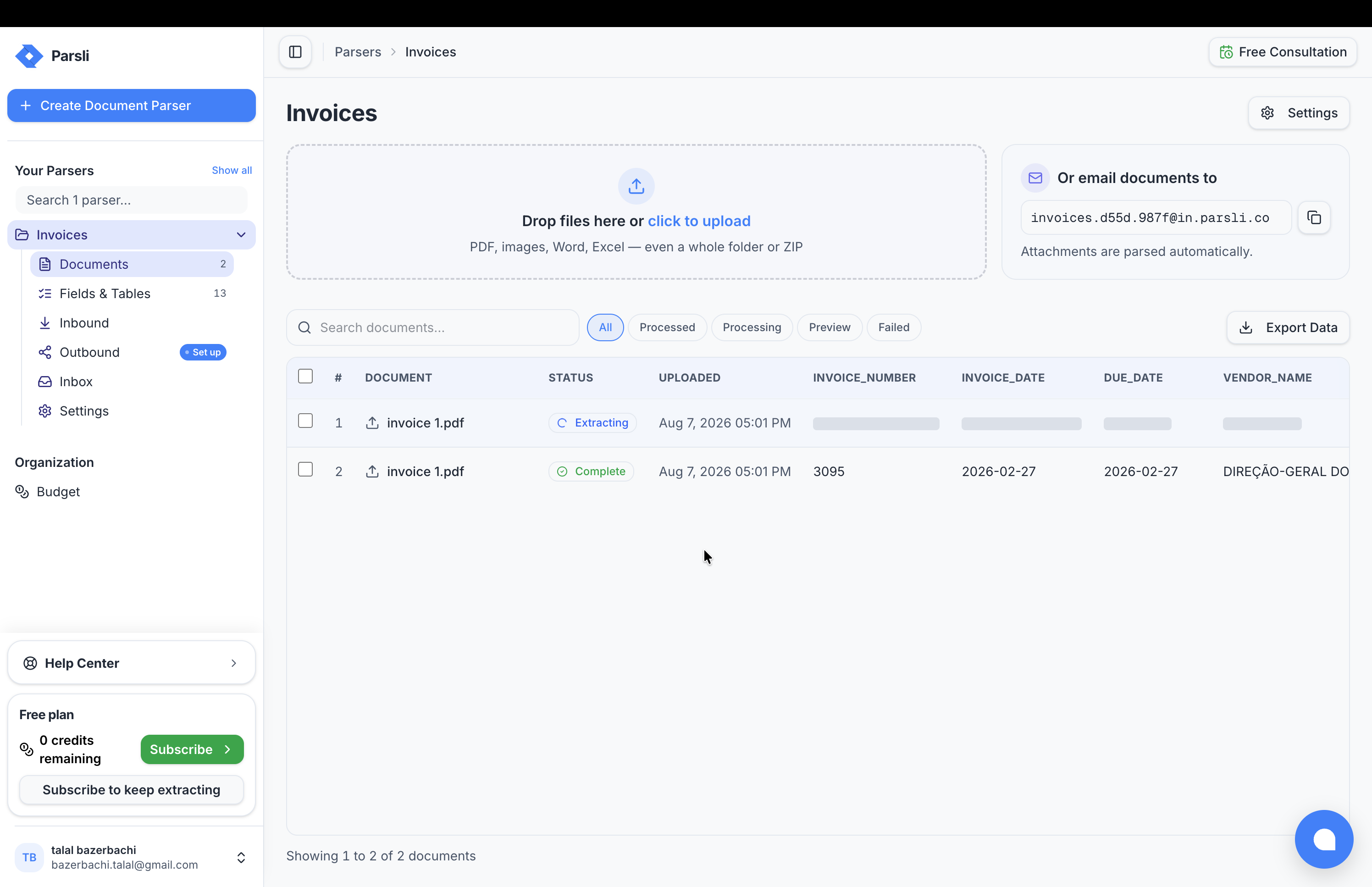
A document is Extracting while it is being read — its value columns show as placeholders — and Complete when it is done. The status filter above the table (a dropdown, or a row of chips on older accounts) narrows to Processed, Processing, Preview, or Failed, and the search box matches file names and any extracted value.
Open a row — the eye icon at its right edge — to see the source document alongside what was pulled out of it. A file list down the left edge of that view moves you to the next document without going back to the table.
Reading a result
Three things are worth attention.
Empty values. A field the engine could not ground in the document comes back empty — not guessed. This is deliberate, and it is a feature: a blank is a fact about your document, whereas a confident wrong number is a liability. An empty due_date usually means no due date was printed.
Confidence. Values the engine is less sure about are flagged. Low confidence is not an error; it is a request that a human look before the number goes into a ledger.
Tables. Table fields come back as rows. If a table is missing rows, that is a field-definition problem rather than a reading problem — see below.
Diagnosing a wrong extraction
Work in this order. It is roughly the order of how often each one is the actual cause.
1. Is the field name ambiguous?
By far the most common cause. amount on a document with a subtotal, a tax line, and a total is a coin toss. total_including_tax is not.
Rename it. This fixes more than any other single change.
2. Is the type wrong?
A currency amount typed string comes back as a string — symbol, separators and all. A date typed string comes back however it was printed.
Set decimal for money, date for dates, number for counts.
3. Would a description help?
One sentence: "The final amount payable, after tax and any discount." Descriptions resolve ambiguity that a name alone cannot carry.
4. Is this a genuine edge case?
Conditional rules belong in Extraction instructions — "if there is an early-payment discount, use the discounted total".
5. Is the value actually in the document?
Worth checking before spending an afternoon on the first four. If the due date is not printed anywhere, no configuration produces one. Empty is the correct answer.
Tip: Change one thing, re-run the same document, see what moved. Changing four things at once tells you nothing about which one worked — and each run costs credits.
Reprocessing
Once you have changed a field definition, run documents again to pick up the change. Reprocessing charges pages again, at the same rate.
Two habits that keep this cheap:
- Iterate on one representative document, not the whole batch. One tells you nearly everything a hundred would.
- Use a short document while tuning. A one-page sample costs one page; the forty-page statement costs forty each time you try something.
Missing table rows
If a table returns fewer rows than the document shows, the usual causes are:
- Ambiguous column names.
totalinside a table on an invoice that also has an overall total. Rename toline_total. - The table was modelled as numbered fields.
item_1_price,item_2_pricecannot grow. Use a Table field. See tables and nested data. - Rows continue on a page you did not send. Check the source document is complete.
Documents that fail entirely
A failed extraction is refunded — credits are reserved beforehand and returned on failure, so a failure costs nothing.
If the same document fails twice, the document is usually the problem: a corrupt PDF, an encrypted file, or a scan too degraded to read. Try opening it yourself; if you cannot read it, neither can the engine.
What to do about low-confidence values
Do not ignore them, and do not treat them as errors. Route them.
- Flag required fields so their absence is visible rather than silent.
- Check before posting to a ledger. See accounting systems.
- Handle empties in code. A
nulltotal should reach a person, not become a zero. See webhooks.
The point is not to eliminate uncertainty — some documents genuinely are ambiguous — but to make sure uncertainty reaches a human instead of a database.
Something here wrong or missing? Tell us — we treat it as a bug.